Is My Practice Interventional? The Importance of a Practice Assessment

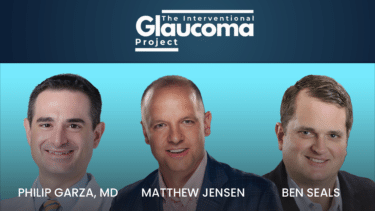
In the first video in a series assessing trends in interventional glaucoma care, host of The Interventional Glaucoma Project, Matt Jensen, of MJM / Marjen, spoke with Mark Gallardo, MD, of El Paso Eye Surgeons, about the interventional nature of his practice. After conducting a practice assessment, Dr. Gallardo determined that his approach to care was not as interventional as he had thought. Watch this episode to hear more about how you can take stock of your practice to see if it aligns with your treatment and management preferences.
Matt Jensen:
Well, hello, everybody, and welcome to The Interventional Glaucoma Project, a series where we’re talking about how to become IG and, really, how to measure yourself to know for sure that you’re truly interventional.
I’m Matt Jensen, and I’m going to be the host of this 6-part series, an educational series where we’re talking about what practices who are interventional, how they differ from practices who just think they are, or maybe want to be more so. I’m joined here with my friend Mark Gallardo from El Paso, Texas. Hey, Mark.
Mark Gallardo, MD:
Hey, Matt. How are you doing?
Matt Jensen:
Really good. Mark, for a long time, you have been meeting the needs of your patients in El Paso. Maybe, just before we get started, give a sense of the kind of program that you have. Because, on one hand, you’ve got a lot of underserved population, and yet you have this beautiful facility that you’ve built, and this great patient experience that you want to treat them well with, as well. Give us some background there.
Mark Gallardo, MD:
We are the only tertiary referral glaucoma center in the region. I really wanted to establish a center that was world-renowned where people from all over the world would want to travel and come to our center but I wanted that for the people of my hometown, so that they didn’t have to go to a place like Dallas or Phoenix to walk into a facility that was just beautiful in nature, but also very caring and comforting at the same time.
Matt Jensen:
Now, a decade ago… a little bit more, actually… 15 years or so, a new category started to emerge. Drops were mainline therapy, and then there were some bigger procedures over here: the tubes and trabs. Boy, more drop therapies was what was in between there.
Then there was the creation of the MIGS category, and a lot of great technologies existed there. But now, there’s so much happening in this in-between stage, where a lot of people question whether or not drops actually should be first-line therapy because some of these interventions that are more procedural, like procedural pharmaceuticals or interventional procedures, might actually stabilize people and be more preventative than a drop therapy.1
Say more about the category and why interventional glaucoma is becoming such a buzzword right now in our field.
Mark Gallardo, MD:
I think there’s really 2 categories there: there’s MIGS, and then there’s interventional glaucoma. MIGS really redefined how we manage glaucoma patients. Because, for many years, as you mentioned, it was drop, drop, drop, drop… maybe laser trabeculoplasty. Then we would wait until we saw a patient lose vision before we subjected them to a surgical procedure. Because the procedures that we had back when I did my training 20 years ago were fraught with complications and risks. Trabeculectomies, although very needed, were somewhat risky even in the best hands.
But when we were doing trabeculectomies, we did them to reduce intraocular pressures to a level that was almost subphysiologic in that we were getting into single digits. Everything that we had was compared to a trabeculectomy. When microinvasive technology came out, a lot of people felt that they were ineffective because they were not as robust in the pressure reduction as a trabeculectomy.
But what ended up happening with the utilization of MIGS procedures is that we realized that not everybody needed that single-digit pressure. I think, on top of that though, we found that maintaining a patient’s pressure, if they were at target, while reducing their medication burden, was beneficial to the patient.
It really redefined what we were… We were always wanting to preserve the patient’s visual field and visual acuity, but it redefined what surgical procedures were for. It wasn’t always to bring a pressure down into the single digits. We realized that we can use surgical procedures for other aspects of glaucoma management. A number of studies have been performed over the years. Of course, most of them were looking at intraocular pressure and medications, but some people started to realize, of course, that there’s more important things than that, and that’s the actual preservation of the visual field and quality of life.
It made us really rethink: Are drops really what’s best for patients? Then, of course, we started looking at the local side effects of topical therapy. All of that combined is what led to interventional glaucoma. It made us really rethink what we’re doing for patients. It’s not just doing a MIGS procedure in conjunction with cataract surgery, but more about intervening earlier to try to help preserve not only the visual field but improve quality of life, preserve that conventional outflow system, and, all the while, making sure their optic nerve isn’t dying.
Matt Jensen:
Well, so you teed us up nicely to transition to the next part of our conversation. Let’s get down to that. If I were to talk to you 18 months ago or so, and said, “Dr. Gallardo, are you interventional as far as glaucoma is concerned?” You would’ve said, “For sure. I’m interventional.” But yet, about a year ago, you did some work within your practice to maybe uncover that you could be more so.
Tell me about what happened, and what… You did an internal assessment. What did that entail?
Mark Gallardo, MD:
So 18 months ago, I would’ve said that I was. But after doing a practice assessment, I realized that, at the time, I wasn’t. That was, in large part, because when I was managing my glaucoma patients, I was really stuck in what I was doing for the last 20 years, where I was doing drop after drop after drop.
But now, with all of the data that we have available, like the LiGHT trial, I’ve realized that there’s more to managing a glaucoma patient than just managing an intraocular pressure, where I’m looking at the patient’s local side effects, I’m looking at the patient’s compliance, I’m looking at the patient’s burden to buying medications, and I have conversations with my patients.
I realize now, after prospectively managing patients, that I wasn’t really taking the time to determine whether or not the best method of managing that patient was solely pharmaceutical versus interventional. I would recommend that people go back, or docs go back, and maybe go back the past year, or even the past month, and evaluate what they’re doing for patients on a daily basis to see if they’re truly interventional in nature.
Matt Jensen:
When you say interventional… because I’m a former administrator, I ran a big practice in the upper mid and mountain west, I have to keep it pretty simple for myself. But it’s procedure first, and then drops is kind of a bridge to further procedures to basically fend off the progression of the disease.
Do I have that about right?
Mark Gallardo, MD:
You do. You do. What’s really interesting though, is that I’m going to give myself a little out, or a little excuse, and say that a lot of the data that we got came about about 2 years ago. Especially the LiGHT trial. That’s really propelled me when I see a new patient to say, “You know what? This study came out that showed that if I start your therapy with this very benign and effective laser treatment, long-term, you’ll tend to need fewer medicines. We’ll have a reduced risk for the need of incisional surgery, and better preservation of your visual field than if we started with drops.”
I’ve found that I didn’t do that so much 2 years ago, but because of the LiGHT trial, when having a new patient in front of me, I’m offering that to them. But in addition to that though, even if I have a patient that’s been controlled on a few medicines over the last decade, when I’m viewing them as an individual, I start to ask them how they’re doing with their medicines overall, and if I can reduce their medication burden with a very benign procedure, if they would want that. Invariably, almost all my patients say, “Do what you can to minimize my drops.”
Matt Jensen:
Dr. Gallardo… so let’s say that you’re talking to somebody who wants to become more interventional. What is the best first step for them to take?
Mark Gallardo, MD:
Really, it’s a matter of assessing your own clinical practice. The way we did that is, we went back 2 years, and using a query system in our electronic health system, we queried the system for all patients that had glaucoma within that 2-week period, and then we followed that group of patients using CPT codes throughout a 2-year period, and evaluated the type and number of procedures they had, as well as documented the severity of their disease state.
Matt Jensen:
Dr. Gallardo, you found, like many doctors, that while you thought you were seeing a lot of end-of-liners, refractory patients in the glaucoma world, they were earlier in their process.
Tell me what you found with your assessment?
Mark Gallardo, MD:
We’re a tertiary referral glaucoma center, and, day in, day out, I see a lot of patients with advanced disease. I presumed that a majority of my patients had end-stage glaucoma. But what we found from our practice assessment is only a third of those patients actually had severe disease, whereas over two-thirds of my patients had mild to moderate. It allowed me to be able to intervene much earlier for a lot of these patients. Again, it goes back to me assessing my clinical practice.
One thing I thought was, that if I was managing my patients with topical therapy, they would be more engaged and more active in their treatment process. But if I did something interventional like a laser trabeculoplasty and got them off of medications, I might lose them in terms of being lost to follow-up. But what I found in my practice assessment is that if I was solely managing a patient on topical therapy, they had a 50% higher rate of being lost to follow-up than if I did something interventional.
Matt Jensen:
Really interesting.
Mark Gallardo, MD:
On the other hand, if we did something interventional, whether it was an SLT or some other form of incisional surgery, there was only a 20% lapse rate. Just coupling the 2, me inheriting patients because they were unhappy, because all their doctor did was doing drops, and then seeing for myself that those patients, that all I did was treat with drops, disappeared either because they just felt like I wasn’t doing much for them and they wanted to go somewhere else to get some other form of therapy, or they were just plain miserable because the drops were just causing so many local side effects for these patients.
Or maybe, because I did something interventional, the disease became real to them. All of a sudden it was more of… You don’t feel glaucoma. When we’re giving them drops, we’re making them feel worse than their disease is. But by adding that intervention, all of a sudden the disease became real to them. All of a sudden, “You know what? I need to monitor this a little bit closer.”
Matt Jensen:
Mark, one of the things that we’re going to cover in future episodes is exactly what some of those data points are. Because you’re not the only practice…
Mark Gallardo, MD:
No.
Matt Jensen:
… who we’ve talked to who has had this kind of internal assessment. First of all, it takes a lot of guts to raise your hand and say, “I want to know for sure that I am operating my business, my program, my paradigm, the way that I think I am.” Kudos to you. Then, also, to have the desire to change. I’m looking forward to that in our future sessions.
Now, I want to just mention one more thing. Because this assessment then also inspired you. You were part of a group of people who all holed up together. You had a big roundtable to come up with the first-ever glaucoma protocol, from ocular hypertension all the way to refractory. Then, in an order of escalation, in what order, basically, will you escalate care for each stage of that process?
Talk to me about that, and how important is it to have a protocol that you can communicate to your team?
Mark Gallardo, MD:
That was something very exciting to be a part of. I felt like we were writing the Declaration of Independence. But over the past decade, the question that I always receive from docs that wanted to incorporate MIGS into their surgical armamentarium is, “How do you decide which procedure to use next?” I think every MIGS procedure that we have is very valuable. They all work very well.
But when we started to discuss our algorithm, if you will, we knew that not every doctor was going to fit explicitly into that algorithm because of what they’ve been doing over the last decade themselves, or what works best in their hands. But it was a foundation for newer doctors, and even doctors that are currently practicing some form of glaucoma management, to gain an idea of what we felt was kind of the best avenue in managing glaucoma patients.
Part of our mindset was, we wanted to always be able to offer a patient the next step in therapy. Because anybody that practices or manages glaucoma knows that we don’t have that 1 specific therapy that’s going to work in 100% of patients and last for eternity. We’re always preparing for that next event. At the same time, we took all of our knowledge from various publications that have been reported over the last decade that have showed that intervening is really showing a trend to preserving the optic nerve better than drops itself.
That’s how we came up with our starting base. Laser trabeculoplasty is such a benign procedure on patients. It works very well. Now we have very good data to show that it works. That’s where we start. But we don’t have to go from laser to 4 drops before we intervene on the next therapy, because we have so many other devices on the market that we could do as a standalone procedure or in conjunction with cataract surgery, or even procedural pharmaceuticals, that we went from laser to looking at drops as a bridge therapy to procedural pharmaceuticals, drops as a bridge therapy, and then looking at angle-based surgery.
Matt Jensen:
I think that protocol was really inspiring to see as an outsider, because then… while it’s helpful from a surgeon to be able to look and say, “Okay, generally, what might be the next step as this escalates for a patient?” I always think about your team, right? Who is watching you go into the room, into the mystery box, and coming out and not knowing who knows how or why that became this versus that, but to have some kind of blueprint that, the majority of the time, we’re probably going down a pathway that looks like this.
Then I think about how you share care with primary eye care providers out in the community. For them to have something like that too, so they generally kind of understand where a patient is and their progression. I just think it’s very valuable, for a disease that’s coming at us very quickly in the next few years, to be able to spread the care around to all who can help.
Dr. Gallardo, I want to thank you for being on our session tonight to really kick off The Interventional Glaucoma Project, and we’re going to be heading down the pathway of the next 5 sections, really getting into the details about the assessment itself and what kind of micro details we can uncover by looking closely at how we practice. Ultimately, like we said before, it’s going to help your practice and your patients.
I want to thank Glaukos for putting this project together, and thank them for their support and innovation in this category.
Reference
- Gillmann K, Hornbeak DM. Rates of visual field change and functional progression in glaucoma following trabecular microbypass implantation of iStent technologies: a meta-analysis. BMJ Open Ophthalmol. 2024;9(1):e001575. doi:10.1136/bjmophth-2023-001575
INDICATIONS AND USAGE
iDose TR (travoprost intracameral implant) is indicated for the reduction of intraocular pressure (IOP) in patients with open angle glaucoma (OAG) or ocular hypertension (OHT).
IMPORTANT SAFETY INFORMATION for iDose® TR (travoprost intracameral implant) 75 mcg
Dosage and Administration
For ophthalmic intracameral administration. The intracameral administration should be carried out under standard aseptic conditions.
Contraindications
iDose TR is contraindicated in patients with active or suspected ocular or periocular infections, patients with corneal endothelial cell dystrophy (e.g., Fuch’s Dystrophy, corneal guttatae), patients with prior corneal transplantation, or endothelial cell transplants (e.g., Descemet’s Stripping Automated Endothelial Keratoplasty [DSAEK]), patients with hypersensitivity to travoprost or to any other components of the product.
Warnings and Precautions
iDose TR should be used with caution in patients with narrow angles or other angle abnormalities. Monitor patients routinely to confirm the location of the iDose TR at the site of administration. Increased pigmentation of the iris can occur. Iris pigmentation is likely to be permanent.
Adverse Reactions
In controlled studies, the most common ocular adverse reactions reported in 2% to 6% of patients were increases in intraocular pressure, iritis, dry eye, visual field defects, eye pain, ocular hyperaemia, and reduced visual acuity.
Please see full Prescribing Information.
You are encouraged to report all side effects to the FDA. Visit www.fda.gov/medwatch, or call 1-800-FDA-1088. You may also call Glaukos at 1-888-404-1644.
IMPORTANT SAFETY INFORMATION for iStent infinite®
INDICATION FOR USE. The iStent infinite® Trabecular Micro-Bypass System Model iS3 is an implantable device intended to reduce the intraocular pressure (IOP) of the eye. It is indicated for use in adult patients with primary open-angle glaucoma in whom previous medical and surgical treatment has failed. CONTRAINDICATIONS. The iStent infinite is contraindicated in eyes with angle-closure glaucoma where the angle has not been surgically opened, acute traumatic, malignant, active uveitic, or active neovascular glaucoma, discernible congenital anomalies of the anterior chamber (AC) angle, retrobulbar tumor, thyroid eye disease, or Sturge-Weber Syndrome or any other type of condition that may cause elevated episcleral venous pressure. WARNINGS. Gonioscopy should be performed prior to surgery to exclude congenital anomalies of the angle, PAS, rubeosis, or conditions that would prohibit adequate visualization that could lead to improper placement of the stent and pose a hazard. MRI INFORMATION. The iStent infinite is MR-Conditional, i.e., the device is safe for use in a specified MR environment under specified conditions; please see Directions for Use (DFU) label for details. PRECAUTIONS. The surgeon should monitor the patient postoperatively for proper maintenance of IOP. Three out of 61 participants (4.9%) in the pivotal clinical trial were phakic. Therefore, there is insufficient evidence to determine whether the clinical performance of the device may be different in those who are phakic versus in those who are pseudophakic. ADVERSE EVENTS. The most common postoperative adverse events reported in the iStent infinite pivotal trial included IOP increase ≥ 10 mmHg vs. baseline IOP (8.2%), loss of BSCVA ≥ 2 lines (11.5%), ocular surface disease (11.5%), perioperative inflammation (6.6%) and visual field loss ≥ 2.5 dB (6.6%). CAUTION: Federal law restricts this device to sale by, or on the order of, a physician. Please see DFU for a complete list of contraindications, warnings, precautions, and adverse events.
PM-US-2644
Matt Jensen and Dr. Mark Gallardo were compensated by Glaukos for their time.
Related Content