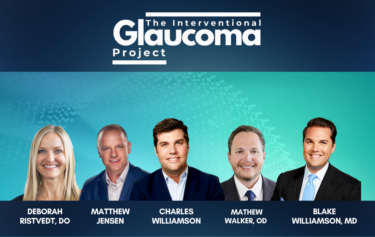
This content was developed in partnership with and is sponsored by Glaukos.
Glaucoma management has undergone a significant shift, moving from a reactive model that prioritizes topical medication as first-line, primary treatment to a more proactive, procedural-first strategy.1 This forward-thinking paradigm, now widely recognized as interventional glaucoma (IG), prioritizes early procedural intervention over prolonged reliance on topical medications.
As a growing pool of evidence supports IG, procedural treatments are no longer solely seen as an adjunct to cataract surgery; they are instead increasingly considered primary options in modern glaucoma care.1
Interventional Glaucoma Treatment
IG has become a prevailing theme among clinicians and industry leaders at medical meetings and symposia, reflecting its growing importance in the specialty. As the field shifts toward earlier, procedure-based interventions, discussions on micro-invasive glaucoma surgery (MIGS), selective laser trabeculoplasty (SLT), and procedural pharmaceuticals are shaping treatment protocols and influencing how glaucoma specialists approach disease management in both academic and real-world settings.2
“The evolution of SLT and procedural pharmaceuticals as first-line therapy has transformed glaucoma care,” said Deborah Ristvedt, DO, of Vance Thompson Vision in Alexandria, Minnesota.
The consensus is that glaucoma surgeons are embracing early intervention. The field is evolving from a place of damage control to prevention—ensuring better long-term outcomes for patients and significantly reducing the need for invasive incisional surgery.3 “The IG approach significantly reduces patient burden, ocular surface disease, and compliance challenges, and it helps maintain stable intraocular pressure (IOP) throughout the day. This is particularly valuable during those mid-morning spikes when pressure tends to rise, ultimately decreasing the possibility of visual field loss,” said Dr. Ristvedt.
Minimally Invasive IOP Management
MIGS devices have revolutionized glaucoma management by enhancing trabecular outflow with minimal invasiveness and reduced topical medication dependence.4,5 MIGS has emerged as a safer, more effective alternative to traditional filtration surgeries, with a lower complication rate and faster recovery time.4,5 These procedures not only facilitate earlier intervention but also serve as an effective adjunct to cataract surgery, providing dual benefits in glaucoma management.
Throughout this evolution, one advancement in glaucoma treatment has been the rise of procedural pharmaceuticals such as the sustained-release travoprost implant iDose® TR (travoprost intracameral implant) 75 mcg (Glaukos), which delivers continuous long-term prostaglandin analog therapy directly into the anterior chamber for IOP control in patients with ocular hypertension or open-angle glaucoma with proven safety and tolerability.6 “By significantly reducing the risk of nonadherence and providing consistent therapeutic effects, without the side effects of topical drops, iDose TR enhances patient quality of life,” said Dr. Ristvedt.
SLT is increasingly recognized as a first-line therapy for glaucoma, offering a safer and more effective alternative to topical medications by reducing IOP through enhanced aqueous outflow via the trabecular meshwork.7 Meanwhile, MIGS devices, including the trabecular micro-bypass device iStent infinite (Glaukos), which improves aqueous humor drainage through the natural outflow pathways, and the XEN Gel Stent (AbbVie), which creates a new drainage channel to the subconjunctival space, have gained traction as viable options for managing refractory glaucoma cases, particularly in patients who are unresponsive to traditional medical and prior surgical treatments.8,9
MIGS has played a pivotal role in the birth of IG, and the rising popularity of procedural pharmaceuticals such as iDose TR further supports this shift. “When we intervene earlier to restore the eye’s natural outflow system, patients do better. Fewer patients need incisional surgery, and we see less visual field loss overall,”10 said Dr. Ristvedt.
Establishing Standardized Guidelines
As the field shifts toward a procedural-first mindset, these minimally invasive surgical and procedural pharmaceutical innovations are reshaping glaucoma treatment, allowing clinicians to prioritize early, targeted interventions over long-term dependence on topical medications. A group of glaucoma specialists, including Dr. Ristvedt and 10 others, saw a need for the establishment of a clear IG treatment protocol to share with their peers.3 They gathered to discuss the IG evolution and define ways to adapt the changes to a glaucoma treatment algorithm.
From that meeting, the Interventional Glaucoma Working Group (IGWG) was born. They developed a structured treatment protocol tailored to each stage of glaucoma, from ocular hypertension to severe disease. “As more ophthalmic surgeons recognize the advantages of the IG approach, a set of standardized guidelines will help facilitate implementation and ensure optimal patient outcomes,” said Dr. Ristvedt.
The protocol prioritizes patient-centric factors such as adherence, the importance of IOP reduction, and a stepwise approach—integrating lasers, MIGS, procedural pharmaceuticals, filtering surgery, and topical medications—to guide providers in adopting IG principles for optimized patient care. A paper detailing IGWG’s discussion and suggested IG guidelines was published in Expert Review of Ophthalmology in February.3 “The consensus reflects the current treatment landscape and naturally will be subject to adjustments as new technologies and evidence emerge,” said Dr. Ristvedt.
Practice Management Implications
While the IG evolution brings well-documented advantages—such as improved vision preservation—it also introduces challenges, including clinic workflow, scheduling, staffing, billing, and patient education. “To accommodate this shift toward IG, I restructured our practice workflow, emphasizing a team-based referral strategy where optometrists identify and refer patients [who need] procedural pharmaceuticals or SLT as a first-line therapy or MIGS procedures like the iStent infinite. This procedural intervention approach allows me to treat patients with controlled or uncontrolled IOP, with zero to high medication burden more effectively,” said Dr. Ristvedt. “By evolving into a procedural-based practice, I am able to fully integrate IG principles, ensuring earlier procedural interventions and focusing on long-term patient outcomes.”
For practices expanding into IG, one of the most immediate changes involves clinic scheduling and workflow adjustments. Rather than focusing predominantly on medication follow-ups, practices may also need to allocate time for preoperative evaluations. Establishing dedicated procedural days or adjusting appointment structures can help accommodate these treatments while maintaining efficiency. Additionally, staff training is critical, as technicians and optometrists may take on expanded roles in preoperative evaluations, post-procedure care, and patient counseling. Regular training sessions on MIGS devices, SLT techniques, and procedural pharmaceuticals can ensure a smooth transition and improve patient outcomes.
Billing and reimbursement also require optimization, as administrative staff may need training on procedural coding to ensure accurate billing for procedural interventions, postoperative visits, and procedural pharmaceuticals. Another critical factor is patient education and informed consent.11 Many glaucoma patients are accustomed to topical medications and may be hesitant to consider laser or procedural pharmaceutical options. Providing structured pre-procedure counseling can help patients appreciate the reduction in burden of administering eye drops.
The Era of Interventional Glaucoma
Early procedural intervention in glaucoma management has demonstrated significant advantages over traditional, topical pharmacological approaches, particularly in terms of long-term IOP control, patient adherence, and disease progression. Studies indicate that delaying surgical intervention in favor of prolonged medication use often results in continued optic nerve damage despite IOP reductions.12
The growing body of evidence supporting MIGS, laser therapies, and procedural pharmaceuticals suggests that this interventional approach is poised to become the new standard of care in glaucoma treatment, redefining the management paradigm for improved patient outcomes.
Disclosures: Dr. Ristvedt is a consultant and speaker for AbbVie, Alcon, and Glaukos.
References
- Micheletti JM, Brink M, Brubaker JW, Ristvedt D, Sarkisian SR. Standalone interventional glaucoma: an evolution from the combination-cataract paradigm. J Cataract Refract Surg. 2024;50(12):1284-1290. doi:10.1097/j.jcrs.0000000000001537
- Yadgarov A, Provencher L, Shafer B, et al. Adopting interventional glaucoma via sustained-release therapies: the wide-ranging impact of procedural pharmaceuticals in ophthalmology. Ophthalmol Ther. 2024;13(11):2825-2838. doi:10.1007/s40123-024-01041-7
- Funke CM, Ristvedt D, Yadgarov A, Micheletti JM. Interventional glaucoma consensus treatment protocol. Expert Rev Ophthalmol. 2025;1-9. doi:10.1080/17469899.2025.2465330
- Gillmann KH, Hornbeak DM. Rates of visual field change and functional progression in glaucoma following trabecular micro-bypass implantation of iStent technologies: a meta-analysis. BMJ Open Ophthalmol. 2024;9(1):e001575. doi:10.1136/bmjophth-2023-001575
- Komzak K, Allen PL, Toh T. Minimally invasive glaucoma surgery: comparison of Hydrus microstent with iStent inject in primary open-angle glaucoma. BMJ Open Ophthalmol. 2025;10(1):e001946. doi:10.1136/bmjophth-2024-001946
- Glaukos Corporation. Data on File. iDose TR®. Phase 3 clinical trials.
- Gazzard G, Konstantakopoulou E, Garway-Heath D, et al. Laser in glaucoma and ocular hypertension (LiGHT) trial: six-year results of primary selective laser trabeculoplasty versus eye drops for the treatment of glaucoma and ocular hypertension. Ophthalmology. 2023;130(2):139-151. doi:10.1016/j.ophtha.2022.09.009
- Gazzard G, Konstantakopoulou E, Garway-Heath D, et al. Laser in glaucoma and ocular hypertension (LiGHT) trial: six-year results of primary selective laser trabeculoplasty versus eye drops for the treatment of glaucoma and ocular hypertension. Ophthalmology. 2023;130(2):139-151. doi:10.1016/j.ophtha.2022.09.009
- Sarenac T, Turkanović AB, Ferme P, Gračner T. A review of selective laser trabeculoplasty: “the hype is real.” J Clin Med. 2022;11(13):3879. doi:10.3390/jcm11133879
- Micheletti JM, Brink M, Brubaker JW, Ristvedt D, Sarkisian SR. Standalone interventional glaucoma: evolution from the combination-cataract paradigm. J Cataract Refract Surg. 2024;50(12):1284-1290. doi:10.1097/j.jcrs.0000000000001537
- Katz LJ, Myers JS, Herndon LW, Kresch YS, Hengerer FH. Interventional glaucoma: improving the patient-provider educational exchange. Clin Ophthalmol. 2024;18:3365-3374. doi:10.2147/OPTH.S491287
- Weinreb RN, Aung T, Medeiros FA. The pathophysiology and treatment of glaucoma: a review. JAMA. 2014;311(18):1901-1911. doi:10.1001/jama.2014.3192
INDICATIONS AND USAGE
iDose TR (travoprost intracameral implant) is indicated for the reduction of intraocular pressure (IOP) in patients with open angle glaucoma (OAG) or ocular hypertension (OHT).
IMPORTANT SAFETY INFORMATION for iDose® TR (travoprost intracameral implant) 75 mcg
Dosage and Administration
For ophthalmic intracameral administration. The intracameral administration should be carried out under standard aseptic conditions.
Contraindications
iDose TR is contraindicated in patients with active or suspected ocular or periocular infections, patients with corneal endothelial cell dystrophy (e.g., Fuch’s Dystrophy, corneal guttatae), patients with prior corneal transplantation, or endothelial cell transplants (e.g., Descemet’s Stripping Automated Endothelial Keratoplasty [DSAEK]), patients with hypersensitivity to travoprost or to any other components of the product.
Warnings and Precautions
iDose TR should be used with caution in patients with narrow angles or other angle abnormalities. Monitor patients routinely to confirm the location of the iDose TR at the site of administration. Increased pigmentation of the iris can occur. Iris pigmentation is likely to be permanent.
Adverse Reactions
In controlled studies, the most common ocular adverse reactions reported in 2% to 6% of patients were increases in intraocular pressure, iritis, dry eye, visual field defects, eye pain, ocular hyperaemia, and reduced visual acuity.
Please see full Prescribing Information.
You are encouraged to report all side effects to the FDA. Visit www.fda.gov/medwatch, or call 1-800-FDA-1088. You may also call Glaukos at 1-888-404-1644.
IMPORTANT SAFETY INFORMATION for iStent infinite®
INDICATION FOR USE. The iStent infinite® Trabecular Micro-Bypass System Model iS3 is an implantable device intended to reduce the intraocular pressure (IOP) of the eye. It is indicated for use in adult patients with primary open-angle glaucoma in whom previous medical and surgical treatment has failed. CONTRAINDICATIONS. The iStent infinite is contraindicated in eyes with angle-closure glaucoma where the angle has not been surgically opened, acute traumatic, malignant, active uveitic, or active neovascular glaucoma, discernible congenital anomalies of the anterior chamber (AC) angle, retrobulbar tumor, thyroid eye disease, or Sturge-Weber Syndrome or any other type of condition that may cause elevated episcleral venous pressure. WARNINGS. Gonioscopy should be performed prior to surgery to exclude congenital anomalies of the angle, PAS, rubeosis, or conditions that would prohibit adequate visualization that could lead to improper placement of the stent and pose a hazard. MRI INFORMATION. The iStent infinite is MR-Conditional, i.e., the device is safe for use in a specified MR environment under specified conditions; please see Directions for Use (DFU) label for details. PRECAUTIONS. The surgeon should monitor the patient postoperatively for proper maintenance of IOP. Three out of 61 participants (4.9%) in the pivotal clinical trial were phakic. Therefore, there is insufficient evidence to determine whether the clinical performance of the device may be different in those who are phakic versus in those who are pseudophakic. ADVERSE EVENTS. The most common postoperative adverse events reported in the iStent infinite pivotal trial included IOP increase ≥ 10 mmHg vs. baseline IOP (8.2%), loss of BSCVA ≥ 2 lines (11.5%), ocular surface disease (11.5%), perioperative inflammation (6.6%) and visual field loss ≥ 2.5 dB (6.6%). CAUTION: Federal law restricts this device to sale by, or on the order of, a physician. Please see DFU for a complete list of contraindications, warnings, precautions, and adverse events.
PM-US-2633
Dr. Ristvedt was compensated by Glaukos for her time.
Related Content