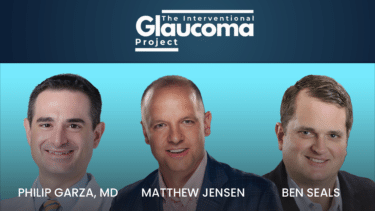
Deep Dive: An Early and Intentional Interventional Approach to Glaucoma Care

In the second video in a series assessing trends in interventional glaucoma care, host of The Interventional Glaucoma Project, Matt Jensen, of MJM / Marjen, speaks with Blake Williamson, MD, and Charles Williamson, both of the Williamson Eye Center, about their practice assessment findings. Among several findings, the assessment indicated that procedural intervention for patients with glaucoma could result in a 3-fold lower lapse rate at the practice.
Watch segment 1 of this series where Matt interviews Dr. Mark Gallardo about his practice.
Matt Jensen:
Well, hello everybody, and welcome to the Interventional Glaucoma Project. I’m Matt Jensen. I’m going to be helping moderate this session. It’s session 2 of 6 of The Interventional Glaucoma Project, the IG Project, and it’s really a practical application of how we implement IG concepts into the practice.
I think it is really easy to believe. We know that we mostly as a category, ophthalmologists and practice managers, believe that IG is the right thing to do for a patient to kind of arrest the progression of this debilitating disease and to do so on behalf of patients and to reduce their dependence on drops that are frustrating, can be expensive, and can have some adverse events. Yet what we find, even though it’s been talked about for 10 years, some of the earliest writings on IG were in 2015, yet some data shows that we’re really not implementing it much differently than we did a decade ago, even though there’s been a lot of innovation. These sessions are really set aside to try to figure out how do we do more to intervene on behalf of our patients and how do we bring our team along?
Now I’m excited to introduce to you friends of mine, the Williamson brothers, they sound like a band and they act like it. They’re good mentors of mine, their practice, and we’ve collaborated a lot over the years, as our practice in Vance Thompson Vision on the upper mid and mountain west was developing its strategies. I’m here with Dr. Blake Williamson and Chuck Williamson, their administrator and CEO.
Blake Williamson, MD:
This is fun to do with my brother. My brother has been such a leader in our practice and as busy surgeons, honestly, a lot of times we just kind of, they point us in a direction, our scribes and our nurses point us, oh, next patient up. We kind of focus a bit on what we’re doing. Chuck has sort of led this deep dive into our practice that we’ll talk about today. I really appreciate him be willing to share what they found and to you, Matt, to guiding us.
Matt Jensen:
Well, you guys have done something interesting in your practice. Chuck, a few months back, they came in with some of their reimbursement folks and specialists to take a look at what you’re doing now. Kind of a practice assessment, right?
Charles Williamson:
Sure.
Matt Jensen:
Because what we say we believe about how we act can be different than it happens in real time. Just give us a little bit of background. What was the assessment like and what did you find?
Charles Williamson:
Absolutely. The assessment was, forgive the pun, eye-opening for us, getting to really dig into the deep data and see what our practice pattern has truly been like versus what we thought it was like was something different. To some extent, we have had some adoption, significant adoption of interventional procedures and interventional treatments. But overall as a practice, finding things like lapse rate was the biggest thing for me. Truly seeing how many of our glaucoma patients lapse out of the practice without a procedure, meaning those people who haven’t had anything interventional not coming back to see us within a year’s time. That was pretty eye-opening when you consider that on a practice level, we were somewhere in the neighborhood of 64%, so the number of folks lapsing out of our practice who had had a procedure was much, much less, 22%. Those kinds of deep dives on the assessment were really profound for us.
Matt Jensen:
I want to frame that even more, so let’s set the table with that. You’re taking a look at your past patients who have some degree of glaucoma, OHT all the way through mild, moderate, severe. In looking at their behavior with your practice, their visits, you’re finding that if you treated them, if you put them on a drop therapy, you’re saying roughly 62% of them lapsed, they didn’t return the next year?
Charles Williamson:
That that’s exactly right, absolutely.
Matt Jensen:
And that if you intervened with a procedure, a procedural intervention, whether it’s a procedural pharmaceutical or a laser or maybe a standalone something, that that lapse rate was much lower?
Charles Williamson:
Absolutely, absolutely, by 3-fold.
Matt Jensen:
Dr. Williamson, tell me, what do you infer from that?
Blake Williamson, MD:
Well, I mean, I think that for me it makes sense because anytime you intervene and do something, surgically especially, it sort of reiterates to the patient that they have a problem. It’s almost like referring patients to a retina specialist preoperatively for cataract surgery if you see something in the back of the eye, even if you know they’re not going to do anything with a subtle epiretinal membrane, it almost just makes them understand, oh wait, I do remember that I went and saw another specialist. They still said I could have cataract surgery. But postop, if they’re not happy, you say, “Remember, you have that other thing in the back of the eye?” “Oh, that’s right, because you sent me over there.” When they have something done to their eye, whether it’s a laser or a iStent infinite or an iDose TR, or anything, they very much know that they have a chronic progressive disease called glaucoma and that you did something interventionally, surgically to them, and they just take it more seriously.
I just find that sometimes if you, if they’re going through the motions and they’ve seen the doctor every 6 months and it’s, yep, here’s your drop refill. Of course we get those patients calling in, “Hey, I can’t get there today. We have a sick family member or transportation issues. Can you just refill my latanoprost?” We do, because we don’t want to be ugly or mean to them or have them leave the practice because they’re upset with us. Right? Then what happens? They call again 6 months later, “Hey, I couldn’t get there, would you mind refilling?”
I think that’s why they lapse, is they just get used to that or they just won’t even come in, because they figure everything’s fine. Remember, glaucoma is a silent thief of vision, so doesn’t hurt or cause any pain, it doesn’t change how you see straight ahead. They just assume everything’s all right. Many of them, they have other things in life going on, it’s not just their glaucoma, so it may not be their top priority. Things that are actually hurting or things that are actually causing them dysfunction in that moment probably are their priority, right? Yeah, they’ll go ahead and miss that eye doctor appointment to go to the orthopod or the family doctor or whatever. Those are some of the many reasons why that could be.
Matt Jensen:
Well, and in our previous episode we talked about why some of the perils of drop therapies and while the chemistry is really impressive, patients taking them, like I said, adverse side effects, the cost of them. These are all reasons why patients might kind of fall off the wagon as far as their own adherence. But like you said, here’s how I infer this data, is that if a doctor assigns a patient some drops as their primary therapy or first-line therapy for glaucoma’s progression, that patient likely doesn’t assign an interventional value to that doctor relationship. They still remain relatively transient, to the point where two-thirds of the time, we think we’re managing them and they’re under our care. They don’t agree as evidenced by their feet. Whereas if we intervene and we do a procedure, they assign that value to us, they believe they’re under our care.
I think that it’s a challenge and a real compliment to our surgeon relationships; listen, if you don’t want patients to feel like they’re under management and remain under management, the best, right thing to do to keep them compliant for the long-term and not lapse or be lost to follow-up, interventional procedures.
Blake Williamson, MD:
I never thought about it like that. I mean, a lot of these folks, they’ve been given drops by many doctors, but you’re the guy that actually intervened and did surgery. Oh, that’s my surgeon, that guy or that gal, they did surgery on me. Right, Chuck? I mean, that’s kind of a different, I never thought about it like that. That’s right.
Matt Jensen:
Yeah. I mean, they’re kind of almost nebulous and it’s because they don’t understand I think the inherent risk because it hasn’t been escalated to them. We’ll talk about that in a minute because I think also because we’ve been a drops-first kind of industry or part of health care, we might not be as quick to or as confident in recommending surgery, so that’s a little preview for later in the conversation.
I want to talk about your numbers in particular, Dr. Williamson, because as we’ve done or we’ve looked at some of the data of assessments of other practices, if you look at the existing, the current state, they see a patient, they have to see a patient many, many times before they’ll transition to any kind of procedure. Right? The goal or the underlying definition of interventional glaucoma is a procedure happens earlier or right away, first-line. You’ll intervene at the low 70s marks when the national average is about 30% who might intervene as early at that early point across the board. I wonder, was that purposeful? Did you set up your program a certain way to have it be that higher yield to interventional glaucoma? If so, what did you have to do differently with your mindset to do that?
Blake Williamson, MD:
Well, I think that it starts with your team and making sure that the folks helping you see patients every day understand how you feel. Right? On my end, I have the same 5 gals that kind of travel with me to some of our different locations, and I only see a few, I mean, everything I see is surgical, in general I don’t see general ophthalmology stuff. It’s all sort of preop, postop stuff. They know that if someone’s coming, ends up on my schedule for the day, it’s because they have this chronic progressive disease called glaucoma for which there’s no cure but there’s wonderful, fabulous treatments and that we’re going to offer them something. Right? That’s why they’ve, in general, been referred to me by one of my in-house optometrists that I partner with. They just know that we have that mindset of we got to do something, right?
It started early on, years ago, 10 years ago when I started, I was doing iStent. I remember sneaking eye stents into the Tulane residency program trying to get comfortable using stents because I wanted to do that right out the gate. I had that feeling 10 years ago when I started that this was a wave, MIGS was a wave, interventional glaucoma was a wave, and I wanted to catch it, right? Because I believed after seeing so many patients confusing their drops and they’re putting in steroids instead of their latanoprost for God’s sakes, I saw it all the time down in New Orleans at Tulane. Having that conversation with your team is important.
They know that we believe in doing stuff, we don’t want to sit on our hands. Even if that patient comes in and the IOP is reasonable, but you have a conversation with them and they say, “Yeah, but it’s quite expensive.” Or, “You know what? I have 30 things on my med chart and I do forget to take my drops.” You realize they’re not compliant. Expressing that to your team, taking them out for a team lunch and saying, “Hey guys, how do you feel about our glaucoma patients? Here’s what I’m noticing. What do you think?” I think that’s maybe how you can start.
What I did specifically to get my average from 73% to 31% of the national average is you have to kind of employ your billing team too. Right? Now the way it works is is that when I have my list of patients for the following week, my team has already looked and seen who there is a glaucoma patient, who’s there a cataract patient, who’s their LASIK or ICL eval. For all the glaucoma folks, they’ve already had a conversation via email with our billing staff to say, “Hey, what MIGS options are we going to be able to offer this patient? We know Dr. Williamson is going to want to do a MIGS, whether it’s standalone or combination with phaco. What can this patient have that their insurance will cover?” Being very proactive ahead of time has allowed me greater comfort with suggesting a MIGS procedure in the actual consult.
Matt Jensen:
Yeah, and I’d like to talk to you about that, Chuck. As the business head of the organization, so you’ve now got not only with Dr. Williamson, but others, we’re looking out ahead to prepare ourselves for the week. The schedule isn’t happening to you, you’re affecting the schedule. Talk about how you got the team involved with that and how detailed do they get?
Charles Williamson:
Yeah, absolutely. My brother hit on something that’s very important relative to forward-looking assessments of the schedule, and that’s the eligibility factor. So many of our patients coming in day-in, day-out have real opportunity to have an interventional procedure. What it requires our administrative team to do is to go in and see all of those patients with OHT, mild, moderate, or severe glaucoma situation, and go into that file to see what insurance they have, what has been tried and failed, and see what kind of qualifications they have for an interventional procedure. It’s an active role that we’re taking on the administrative side to look ahead at all of the physicians’ schedules to try to mimic what Blake’s team is already doing.
They’ve been doing it as a labor of love to their patients. Before we had some of this really concise data that enables us to look at just the glaucoma patients coming in this week, which we now have. It really took them working through his day-in, day-out schedule and calling our billing and reimbursement team to get that kind of eligibility information. That’s what we have to do in order to be more proactive with the rest of the group, our 14 optometrists and our other MDs, quite frankly.
Matt Jensen:
Well, you bring up an interesting point, and I like the way that you from the admin standpoint, and then you with your clinical team, Blake, have decided, okay, we’re going to look out ahead. We’re going to take a look at the patient load. We’re going to see if they’ve got any preexisting progression, and then when they come in, we’re going to have a recommendation maybe already in mind. But you’re thinking very procedurally minded, in a procedurally minded fashion. We’re doing precisely what only you can do, Blake, which is surgery, surgery, surgery, surgery, intervene, intervene.
Blake Williamson, MD:
I don’t want doctors listening to this to think, well wait, so I have to wait and hear? I should wait and understand exactly which procedures I can offer before I mention it, because the patients are going to be very concerned. Is it a stent or is it a pharmaceutical procedure or what is it? I haven’t found that to be the case. Just understanding the background, what you can do, but then when you’re with the patient, to your point, just recommend.
Matt Jensen:
I think that whatever we decide to educate the patient on, it’s going to be a big deal in their life. But almost like, I’ll put it in Baton Rouge kind of language, the first thing we have to do is we have to set the hook. We have to intervene. We have to make sure that when they leave the office, they’re managed. That’s the way you were talking, I think what you’re trying to hold is on behalf of the patient, Dr. Williamson, I want to be in control. When they leave, I want to know that they’re under control or on their way to it, whereas when we’re doing drop therapies, that is really outside of our realm of influence the moment they leave our office.
Gentlemen, I want to thank you for being a part of this session of the Interventional Glaucoma Project. Lots of great content there and what and how to implement some of these ideas in the practice. I look forward to our next episodes where we get to learn more from your practice, but also from other practices and how they’re learning to intervene earlier with procedures, not just drops, when it comes to glaucoma treatment plans.
INDICATIONS AND USAGE
iDose TR (travoprost intracameral implant) is indicated for the reduction of intraocular pressure (IOP) in patients with open angle glaucoma (OAG) or ocular hypertension (OHT).
IMPORTANT SAFETY INFORMATION for iDose® TR (travoprost intracameral implant) 75 mcg
Dosage and Administration
For ophthalmic intracameral administration. The intracameral administration should be carried out under standard aseptic conditions.
Contraindications
iDose TR is contraindicated in patients with active or suspected ocular or periocular infections, patients with corneal endothelial cell dystrophy (e.g., Fuch’s Dystrophy, corneal guttatae), patients with prior corneal transplantation, or endothelial cell transplants (e.g., Descemet’s Stripping Automated Endothelial Keratoplasty [DSAEK]), patients with hypersensitivity to travoprost or to any other components of the product.
Warnings and Precautions
iDose TR should be used with caution in patients with narrow angles or other angle abnormalities. Monitor patients routinely to confirm the location of the iDose TR at the site of administration. Increased pigmentation of the iris can occur. Iris pigmentation is likely to be permanent.
Adverse Reactions
In controlled studies, the most common ocular adverse reactions reported in 2% to 6% of patients were increases in intraocular pressure, iritis, dry eye, visual field defects, eye pain, ocular hyperaemia, and reduced visual acuity.
Please see full Prescribing Information.
You are encouraged to report all side effects to the FDA. Visit www.fda.gov/medwatch, or call 1-800-FDA-1088. You may also call Glaukos at 1-888-404-1644.
IMPORTANT SAFETY INFORMATION for iStent infinite®
INDICATION FOR USE. The iStent infinite® Trabecular Micro-Bypass System Model iS3 is an implantable device intended to reduce the intraocular pressure (IOP) of the eye. It is indicated for use in adult patients with primary open-angle glaucoma in whom previous medical and surgical treatment has failed. CONTRAINDICATIONS. The iStent infinite is contraindicated in eyes with angle-closure glaucoma where the angle has not been surgically opened, acute traumatic, malignant, active uveitic, or active neovascular glaucoma, discernible congenital anomalies of the anterior chamber (AC) angle, retrobulbar tumor, thyroid eye disease, or Sturge-Weber Syndrome or any other type of condition that may cause elevated episcleral venous pressure. WARNINGS. Gonioscopy should be performed prior to surgery to exclude congenital anomalies of the angle, PAS, rubeosis, or conditions that would prohibit adequate visualization that could lead to improper placement of the stent and pose a hazard. MRI INFORMATION. The iStent infinite is MR-Conditional, i.e., the device is safe for use in a specified MR environment under specified conditions; please see Directions for Use (DFU) label for details. PRECAUTIONS. The surgeon should monitor the patient postoperatively for proper maintenance of IOP. Three out of 61 participants (4.9%) in the pivotal clinical trial were phakic. Therefore, there is insufficient evidence to determine whether the clinical performance of the device may be different in those who are phakic versus in those who are pseudophakic. ADVERSE EVENTS. The most common postoperative adverse events reported in the iStent infinite pivotal trial included IOP increase ≥ 10 mmHg vs. baseline IOP (8.2%), loss of BSCVA ≥ 2 lines (11.5%), ocular surface disease (11.5%), perioperative inflammation (6.6%) and visual field loss ≥ 2.5 dB (6.6%). CAUTION: Federal law restricts this device to sale by, or on the order of, a physician. Please see DFU for a complete list of contraindications, warnings, precautions, and adverse events.
iStent® Trabecular Micro-Bypass System
United States
INDICATION FOR USE
The iStent Trabecular Micro-Bypass Stent (Models GTS100R and GTS100L) is indicated for use in conjunction with cataract surgery for the reduction of intraocular pressure (IOP) in adult patients with mild to moderate open-angle glaucoma currently treated with ocular hypotensive medication.
CONTRAINDICATIONS
The iStent ®is contraindicated in eyes with primary or secondary angle closure glaucoma, including neovascular glaucoma, as well as in patients with retrobulbar tumor, thyroid eye disease, Sturge-Weber Syndrome or any other type of condition that may cause elevated episcleral venous pressure.
WARNINGS
Gonioscopy should be performed prior to surgery to exclude PAS, rubeosis, and other angle abnormalities or conditions that would prohibit adequate visualization of the angle that could lead to improper placement of the stent and pose a hazard. The iStent® is MR-Conditional meaning that the device is safe for use in a specified MR environment under specified conditions, please see label for details.
PRECAUTIONS
The surgeon should monitor the patient postoperatively for proper maintenance of intraocular pressure. The safety and effectiveness of the iStent® has not been established as an alternative to the primary treatment of glaucoma with medications, in children, in eyes with significant prior trauma, chronic inflammation, or an abnormal anterior segment, in pseudophakic patients with glaucoma, in patients with pseudoexfoliative glaucoma, pigmentary, and uveitic glaucoma, in patients with unmedicated IOP less than 22 mmHg or greater than 36 mmHg after washout of medications, or in patients with prior glaucoma surgery of any type including argon laser trabeculoplasty, for implantation of more than a single stent, after complications during cataract surgery, and when implantation has been without concomitant cataract surgery with IOL implantation for visually significant cataract.
ADVERSE EVENTS
The most common post-operative adverse events reported in the randomized pivotal trial included early post-operative corneal edema (8%), BCVA loss of = 1 line at or after the 3 month visit (7%), posterior capsular opacification (6%), stent obstruction (4%) early post-operative anterior chamber cells (3%), and early post-operative corneal abrasion (3%). Please refer to Directions for Use for additional adverse event information.
CAUTION
Federal law restricts this device to sale by, or on the order of, a physician. Please reference the Directions for Use labeling for a complete list of contraindications, warnings, precautions, and adverse events.
PM-US-2641
Matt Jensen, Charles Williamson, and Dr. Blake Williamson were compensated by Glaukos for their time.
Related Content