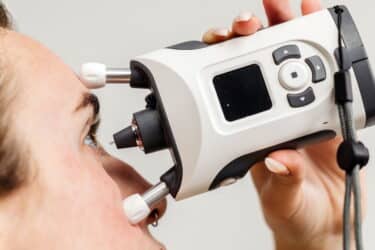

The IRIS Registry (Intelligent Research in Sight) provides the opportunity to examine how Dextenza performs in clinical practice.
By Michael Mbagwu, MD
Post-operative care for cataract surgery typically includes a regiment of topical antibiotics, nonsteroidal anti-inflammatory drugs, and corticosteroids. These traditional eye drop-based therapies, however, are a familiar source of frustration for both patients and surgeons for many reasons.
Adherence to prescribed eye drops, in general, may be difficult for individuals with poor dexterity or issues related to memory. There are also well-known ocular surface side effects associated with preservatives commonly used in these agents. Perhaps most importantly, however, is that these regimens that involve three different eye drops with various dosing and tapering schedules are complex, and along with the other challenges with drops outlined here, greatly contribute to a lack of adherence.
Corticosteroid Drop Alternative
Drug delivery options for topical medications that eliminate the need for administering eye drops are constantly evolving as convenient and effective alternatives. One of these is Dextenza (Ocular Therapeutix), a hydrogel-based intracanalicular insert containing 0.4 mg dexamethasone. The insert releases the drug in a tapered fashion for up to 30 days and contains no antimicrobial preservatives. Dextenza is approved by the Food and Drug Administration (FDA) for the treatment of postoperative ocular inflammation and pain, as well as ocular itching associated with allergic conjunctivitis.1,2 The insert is physician-administered and can be placed in the operating room or the office, reducing challenges with adherence and facilitating consistent corticosteroid delivery.
However, FDA-approved pharmaceuticals may perform differently in clinical practice than they do in a controlled clinical trial setting. My colleagues and I sought to better understand this among surgeons using the insert for cataract surgery patients in real-world clinical practice.3,4 For this, we leveraged real-world data from the American Academy of Ophthalmology IRIS Registry (Intelligent Research in Sight) – the nation’s first comprehensive eye disease clinical registry. As of October 2023, the IRIS Registry included more than 70 million unique patients from more than 430 million visits and nearly 14,000 contributing clinicians. We conducted a retrospective analysis of electronic health record data for patients who underwent cataract surgery between June 1, 2019, and November 30, 2022. Over 1.7 million eyes were included for analysis, of which more than 50,000 received Dextenza.
How Dextenza is Used
A brief overview of patient demographics for our study shows that those receiving Dextenza were on average almost 74 years old, approximately 60% were women, and close to 53% were Medicare recipients. The most common ocular comorbidities in the 6 months preceding cataract surgery were dry eye and other ocular surface diseases (OSD) (32.9% for eyes with the insert; 24.8% for eyes without the insert), glaucoma (23.8% with insert; 23.5% without insert), and age-related macular degeneration (11.4% with insert; 9.0% without insert).
We found it noteworthy that surgeons used the dexamethasone insert more frequently for patients with OSD, and that having glaucoma did not appear to preclude surgeons from using it. In terms of OSD, we certainly know that exposure to preservatives from postoperative three-drug regimens is significant and can exacerbate preexisting disease. Moreover, the product is also approved for allergic eye disease, which also may drive use in patients with concomitant disease.
It also appears surgeons were not selectively restricting Dextenza for patients with glaucoma or a history of glaucoma surgery. The most common glaucoma procedure before cataract surgery was laser trabeculoplasty (69.7%), and 5.9% of the dexamethasone insert patients underwent combined glaucoma and cataract surgery (total of 3,181 eyes; almost all were microinvasive interventional glaucoma surgery/MIGS, n = 3076). This may suggest surgeons were comfortable with the safety of this corticosteroid delivery option to the extent that they used it in patients particularly vulnerable to intraocular pressure (IOP) spikes and optic nerve damage. We even observed some Dextenza use in patients who underwent tube-shunt surgery, which is typically reserved for more advanced glaucoma.
Inflammatory Events
The overall incidence of postoperative inflammatory events within 3 months of cataract surgery was low in both groups, and comparable between patients with Dextenza and those without. Specifically, anterior uveitis occurred in 1.16% of patients with Dextenza and 1.21% of those without, corneal edema in 0.55% and 0.54%, and cystoid macular edema 0.85% and 0.56%, with Dextenza and without, respectively.
Interestingly, anterior uveitis, corneal edema, and cystoid macular edema were documented less frequently in the real world than in the FDA clinical trials of the dexamethasone insert (1.16% vs 9.87%; 0.55% vs 1.40%, and 0.85% vs 1.40%, respectively for the three events).
Intraocular Pressure
In patients without glaucoma, rates of IOP elevation ≥10 mm Hg were comparable between the dexamethasone insert patients and those who did not. This occurred most frequently on postoperative day 1 (day 1: 8.48% for Dextenza vs 8.94% without; day 8: 1.63% vs 1.87%; day 15: 1.22% vs 1.42%; day 22: 0.68% vs 0.95%, and day 29: 0.41% vs 0.65%, with Dextenza and without respectively).
In eyes with preexisting glaucoma, the proportions of IOP elevations ≥10 mm Hg were comparable between eyes treated with the dexamethasone insert and those without during the first postoperative month (day 1: 8.82% with Dextenza vs 9.45% without; day 8: 2.21% vs 3.31%; day 15: 1.94% vs 2.63%; day 22: 1.10% vs 1.70%; day 29: 1.13% vs 1.27%, with the insert and without, respectively).
Conclusion
While rigorous clinical trials are the foundation of medical science, there is increasing importance for understanding how medications and devices work in real-world settings. As evidenced by the real-world use of the insert—based on data gleaned from the IRIS Registry—surgeons can better understand outcomes with Dextenza in patients who have comorbid conditions. I believe the IRIS Registry, and databases like it, will play an important part in the future of evidence-based healthcare for insights like this.
Michael Mbagwu, MD, is senior medical director for Verana Health in San Francisco and Adjunct Clinical Assistant Professor at Stanford University School of Medicine in Stanford, California. He may be reached at [email protected].
References
- Tyson SL, Bafna S, Gira JP; Dextenza Study Group. Multicenter randomized phase 3 study of a sustained-release intracanalicular dexamethasone insert for treatment of ocular inflammation and pain after cataract surgery. J Cataract Refract Surg. 2019;45(2):204-212. doi: 10.1016/j.jcrs.2018.09.023
- McLaurin EB, Evans D, Repke CS, et al. Phase 3 randomized study of efficacy and safety of a dexamethasone intracanalicular insert in patients with allergic conjunctivitis. Am J Ophthalmol. 2021;229:288-300. doi: 10.1016/j.ajo.2021.03.017
- Bovelle R, Mbagwu M, Hatfield M, et al. Real world characteristics of 50,000 patients treated with intracanalicular dexamethasone insert: analysis using IRIS®Registry. Paper presented at: AAO 2023; November 3-6, 2023; San Francisco, CA.
- Xu BY, Mbagwu M, Hatfield M, et al. Real-world safety analysis of 50,000 patients treated with intracanalicular dexamethasone insert using IRIS® Registry. Paper presented at: AAO 2023; November 3-6, 2023; San Francisco, CA.
Related Content